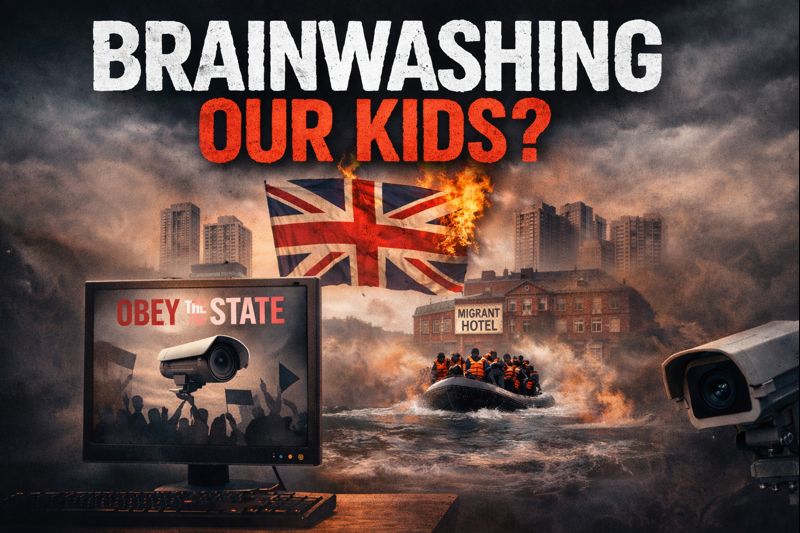
A government-backed video game aimed at preventing radicalisation in children is being criticised for framing traditional British values and dissenting views as dangerous. As the UK grapples with mass migration, border insecurity, and historic failures to protect vulnerable communities, critics warn of an emerging culture of state indoctrination and censorship.
A Game to Prevent Extremism Or a Tool to Reprogramme Thought?
It sounds dystopian, but it’s real. A new classroom resource backed by government-linked funding is turning heads — and not for the right reasons.
The game, called Pathways, is pitched as a tool to “build resilience” in children against radicalisation. But what it arguably does instead is recast normal British teenagers — those who question mass immigration, protest for their culture, or express concern over disappearing national values — as potential extremists.
Players are led through scenarios where, for example, they can be punished for protesting against the erosion of British identity. In some storylines, merely researching immigration online or joining a demonstration prompts a warning that Prevent, the UK’s controversial counter-terrorism strategy, could flag them.
It reads like a training manual for thought-policing — turning our own children against dissent, against protest, and, ultimately, against the values many of us were raised to defend.
Indoctrination in the Classroom?
To some, this game is just another brick in the wall of a broader shift — one where state-funded projects teach children that patriotism is suspect, that questioning government-approved narratives is dangerous, and that traditional British identity is something to be watched closely.
The most striking part? These messages are delivered under the guise of safeguarding.
Prevention has long been controversial. Critics from across the political spectrum have said it casts too wide a net, capturing young people for simply expressing opinions that, not long ago, would have been seen as part of open democratic debate. Now, under projects like Pathways, children are being taught that to speak up about Britain’s changing identity could land them on a watchlist.
And this is all happening at a time when many communities are already feeling betrayed by the state.
Broken Borders, Silent Streets
While the government monitors children for ‘wrongthink’, our borders are wide open.
Thousands of small boat crossings have taken place, with illegal migrants arriving daily on UK shores — many of them housed in hotels paid for by the taxpayer, often in towns and cities where locals can’t even get on a council waiting list. Public services are under strain, and yet dissent against this influx is often labelled xenophobic or far-right.
“Ordinary Brits are shouted down for wanting a say on who enters their country,” says a former civil servant, speaking anonymously. “But then we’ve got the state gamifying radicalisation, and suggesting that just talking about immigration is dangerous.”
Grooming Gangs: A Lesson in State Failure
This isn’t an isolated case of the state losing the plot. For years, systemic child sexual exploitation was allowed to continue in towns like Rotherham, Rochdale, and Telford — with thousands of working-class girls abused by grooming gangs, many of whom operated with impunity while officials turned a blind eye.
Reports have revealed that political correctness, fear of being called racist, and institutional cowardice stopped authorities from acting. The girls were labelled “lifestyle choices,” while abusers were protected.
Now, we’re asking children to report each other for opinions, while the state still hasn’t answered for its silence when real crimes were happening in plain sight.
It raises the question: What does the government see as the greater threat — a teenager wanting to march for British values, or the actual predators that have roamed our streets unchecked?
Are We Criminalising Patriotism?
Not long ago, standing up for Queen and country, waving the Union Jack, or saying you wanted controlled immigration would have been mainstream positions. But under this new moral order, those who still hold those beliefs are being nudged to the margins.
The game warns about people being “groomed” into extremism — but many now feel that children themselves are being groomed into passive acceptance, into distrusting their heritage and fearing their own instincts.
How far are we from a point where questioning state narratives is itself a criminal offence?
Why You Shouldn’t Let Your Child Play This Game
At first glance, Pathways might look like just another educational resource — the sort of tool schools use to tick boxes on safeguarding or digital literacy. But make no mistake: this is not a harmless classroom game. It’s a state-funded tool of ideological conditioning, and many parents may be unaware of what their children are really being exposed to.
Here’s why it matters — and why you should think twice before letting your child anywhere near it:
1. It Redefines Normal Curiosity as Dangerous
In Pathways, children are penalised for expressing views that, in a functioning democracy, should be perfectly valid — like wanting to protest, criticising mass immigration, or standing up for British values. By turning those actions into red flags for extremism, the game sends a chilling message: think like the state or be treated as a threat.
2. It Teaches Distrust and Surveillance Among Peers
One of the game’s core messages is that certain opinions — even those voiced by friends — might mean someone is on the path to radicalisation. This doesn’t teach critical thinking. It teaches suspicion, self-censorship, and fear. Children shouldn’t grow up thinking that free thought is something to report.
3. It Undermines Parental Values
Many parents raise their children to love their country, respect its heritage, and speak up when they see injustice. This game encourages the opposite. It implicitly tells children that if their family’s values don’t align with the state’s ever-shifting ideology, they should question — or even reject — what they’ve learned at home.
4. It Normalises Government Overreach
When a classroom tool starts suggesting that students can be referred to counter-terrorism channels for having opinions, we’re no longer talking about education — we’re talking about behavioural control. Giving your child access to this game means exposing them to the kind of state surveillance culture we once associated with authoritarian regimes.
5. It Puts Pressure on Young Minds
Teenagers are still developing their sense of identity, and they often question the world around them. That’s healthy. But this game tells them that certain questions or instincts are dangerous — especially if they relate to identity, tradition, or nationhood. It teaches conformity, not confidence.
6. It Distracts from Real Threats
The UK faces real challenges: grooming gangs that operated for years unchallenged, rising knife crime, an overwhelmed immigration system. But instead of tackling those head-on, this game shifts the focus to innocent kids who might share a meme or attend a protest. It’s a dangerous distraction from the issues that actually harm our communities.
Bottom Line:
Don’t let your child become part of a social experiment. What looks like a safeguarding tool may actually be a Trojan horse for ideological engineering — one that teaches children to distrust themselves, their families, and their heritage. You wouldn’t hand your child over to a stranger pushing propaganda. So why hand them over to the state in digital form?
What’s the Endgame?
There is a deep irony in all this. In trying to protect children from ideological manipulation, the state may well be doing the very thing it claims to oppose — indoctrinating the next generation.
While border control collapses, while communities live with the legacy of ignored abuse scandals, and while national identity is chipped away bit by bit, we’re teaching our children that loyalty to Britain is suspect, and silence is safer than speech.
This isn’t just about a game. It’s about the growing divide between the governed and those who govern. It’s about trust. And many are wondering — once that’s gone, what’s left?
Hi, I’m Sarah Jade. I’m 25, Yorkshire born stubborn redhead, and just finding my feet in the wild world of independent journalism.I’ve always had this fire in me for telling real stories, the kind that actually mean something. I love the British spirit, the blunt honesty, the humour, and yes… I do get emotional about free speech and the truth. I’m not perfect, but I care deeply about people, fairness, and saying what others might be too scared to.